
From Test Volume to Engineering Confidence: What Good Looks Like in AI Data Center Validation
Moving beyond test volume to measure risk, system interactions, and true platform reliability across AI infrastructure


Artificial Intelligence is fundamentally reshaping data centers, and with it, the discipline of post-silicon validation.
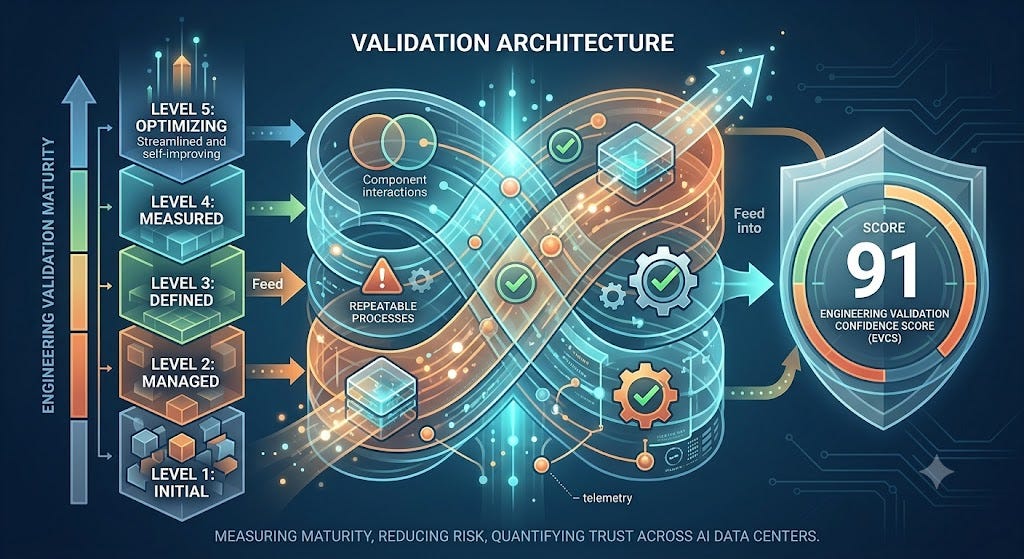
Validation is no longer just about proving that a chip meets its specification. Today’s AI data centers are living ecosystems where liquid-cooled racks, heterogeneous accelerators, NVMe and CXL fabrics, firmware, operating systems, drivers, Kubernetes clusters, AI services, and autonomous agents continuously interact. CI/CD pipelines no longer deploy only software; they orchestrate firmware updates, infrastructure changes, validation workloads, and increasingly, AI-driven decision-making.
As these systems become more interconnected and autonomous, one question keeps surfacing in engineering labs and quality organizations:
What does “good” look like when validation spans hardware, software, and autonomous tooling?
For years, the industry has measured success through volume: more test cases, more automation, more dashboards, and higher pass percentages. While these metrics are useful operational indicators, they rarely answer the question that engineering leaders care about most:
How much confidence do we actually have in shipping this system?
A platform may execute hundreds of thousands of tests with a 98% pass rate and still experience failures caused by interactions between firmware and drivers, memory and networking, storage and AI workloads, or autonomous agents making incorrect operational decisions. In AI infrastructure, failures increasingly occur at the boundaries between components rather than within the components themselves.
It is time to redefine what “good” means.
Instead of equating good validation with execution volume, we should equate it with engineering maturity, our ability to demonstrate, through measurable evidence, that validation activities reduce system risk and increase operational reliability.
For post-silicon and hardware validation engineers, this means moving beyond heroic bringup efforts and custom scripts toward explicit validation strategies, clearly defined exit criteria, and orchestration patterns that survive multiple product generations and organizational change. For software quality leaders, it means treating AI agents, CI/CD pipelines, and automation frameworks as engineering systems that must earn trust through quantitative evidence. Agent reliability, safety compliance, delegation accuracy, traceability, and operational cost should become first-class quality metrics rather than afterthoughts.
A Practical Framework for Engineering Confidence
To move from aspiration to execution, AI data center validation can be viewed through
three complementary pillars.
Validation Architecture: Validation should begin with an intentional architecture rather than an accumulation of test suites. The architecture defines how hardware, firmware, operating systems, drivers, AI frameworks, cloud infrastructure, and autonomous agents interact throughout the validation lifecycle. It identifies ownership of engineering risks, structures CI/CD quality
gates, connects lab orchestration with production telemetry, and ensures that validation is designed around system interactions, not isolated components.
Instead of asking, “Did every component pass?”, organizations should ask:
“Did we validate every critical interaction across the system?”
Engineering Validation Maturity (EVM): Architecture alone is insufficient without organizational discipline. An Engineering Validation Maturity (EVM) model provides a structured way to evaluate how consistently validation practices are applied across teams. Inspired by process maturity frameworks such as TMMi but adapted for AI infrastructure and post-silicon environments, EVM focuses on engineering capability rather than compliance.
Rather than measuring how many tests exist, maturity evaluates whether organizations have:
Shared validation strategies
Repeatable engineering processes
Risk-based validation planning
System level interaction coverage
Continuous feedback from production
Quantitative evidence supporting release decisions
Maturity shifts the conversation from “Are we finished testing?” to:
“How mature is our validation capability?”
Engineering Validation Confidence Score (EVCS): Engineering leaders also need an executive-level measure that communicates confidence, not simply activity. An Engineering Validation Confidence Score (EVCS) combines multiple dimensions into a single engineering health indicator. Rather than reporting only test pass rates or automation percentages, EVCS evaluates factors such as:
Risk coverage across the platform
Reliability confidence
Recovery and resiliency validation
AI agent trustworthiness and safety
Observability and diagnostic capability
Defect leakage trends
Cost efficiency of validation activities
Speed at which production incidents become new validation assets
An EVCS of 91 out of 100 communicates far more than “98% of tests passed.” It demonstrates whether validation has meaningfully reduced engineering risk and increased confidence in the platform.
From Automation to Measured Reliability
Good AI data center validation is not defined by statements like:
“We automated the lab.”
or
“We integrated AI into our testing.”
Instead, good validation can confidently say:
“We can demonstrate, with measurable evidence, how our validation architecture reduces risk, improves resilience, and continuously strengthens the reliability of our AI infrastructure.”
This requires evaluating autonomous agents with the same rigor applied to firmware and software, validating cost and capacity guardrails alongside performance, and ensuring that production telemetry continuously improves future validation strategies. Validation becomes a living engineering system, where development, validation, deployment, telemetry, and failure learning form a continuous feedback loop. When validation operates through architecture, maturity, and measurable confidence, innovation stops being a collection of impressive tools and becomes an engineering capability that consistently transforms complexity into reliability.
Looking Ahead
The future of post-silicon validation will not be defined by larger test suites or increasingly sophisticated AI tools. It will be defined by our ability to engineer confidence across an evolving ecosystem of hardware, firmware, software, cloud infrastructure, and intelligent agents.
The next generation of quality leaders, whether they come from hardware labs or software QA, will not be recognized for automating more tests. They will be recognized for building validation ecosystems that continuously demonstrate engineering confidence, turning innovation into reliability that can be measured, explained, and trusted.
These concepts build on ongoing research into agent evaluation, agent security test maturity, NVMe validation, and FinOps aligned quality frameworks. Readers interested in detailed models, metrics, and case studies are welcome to refer to my recent publications in these areas, which explore how to implement Engineering Validation
Maturity and Engineering Validation Confidence in real AI data center and post-silicon environments. Selected papers are available on my ResearchGate profile, and I am open to collaborating with other practitioners and researchers who want to advance this work through joint studies, pilots, or future publications.
About the Author:

Lakshmi Vidya Peri is an operations-focused validation engineering and quality transformation leader with over a decade of experience in server, storage, and data center validation. She has led NVMe qualification programs and modernized test orchestration and Lab-as-a-Service capabilities, tripling throughput and reducing time-to-market by 30 percent. Her work spans lab operations, software procurement rationalization, KPI architecture, and Voice-of-Customer driven improvement, often acting as a liaison between engineering, operations, and customer insights.
Her research at Boise State University explored improving ARM Cortex-A8 performance through victim-cache simulation and shift-left pre-silicon SoC modeling, and she continually learns and applies new methods to bring clarity to chaotic systems and align teams around evidence and outcomes. Lakshmi is a TMMi Certified Professional (TMMi-P) and holds additional certifications in marketing analytics, statistics and data science, data center virtualization, organizational leadership, product management, data governance, and cybersecurity awareness. She serves on the TMMi America board, focusing on test maturity, governance, and AI-enabled quality engineering.
 | A guest post by
|